
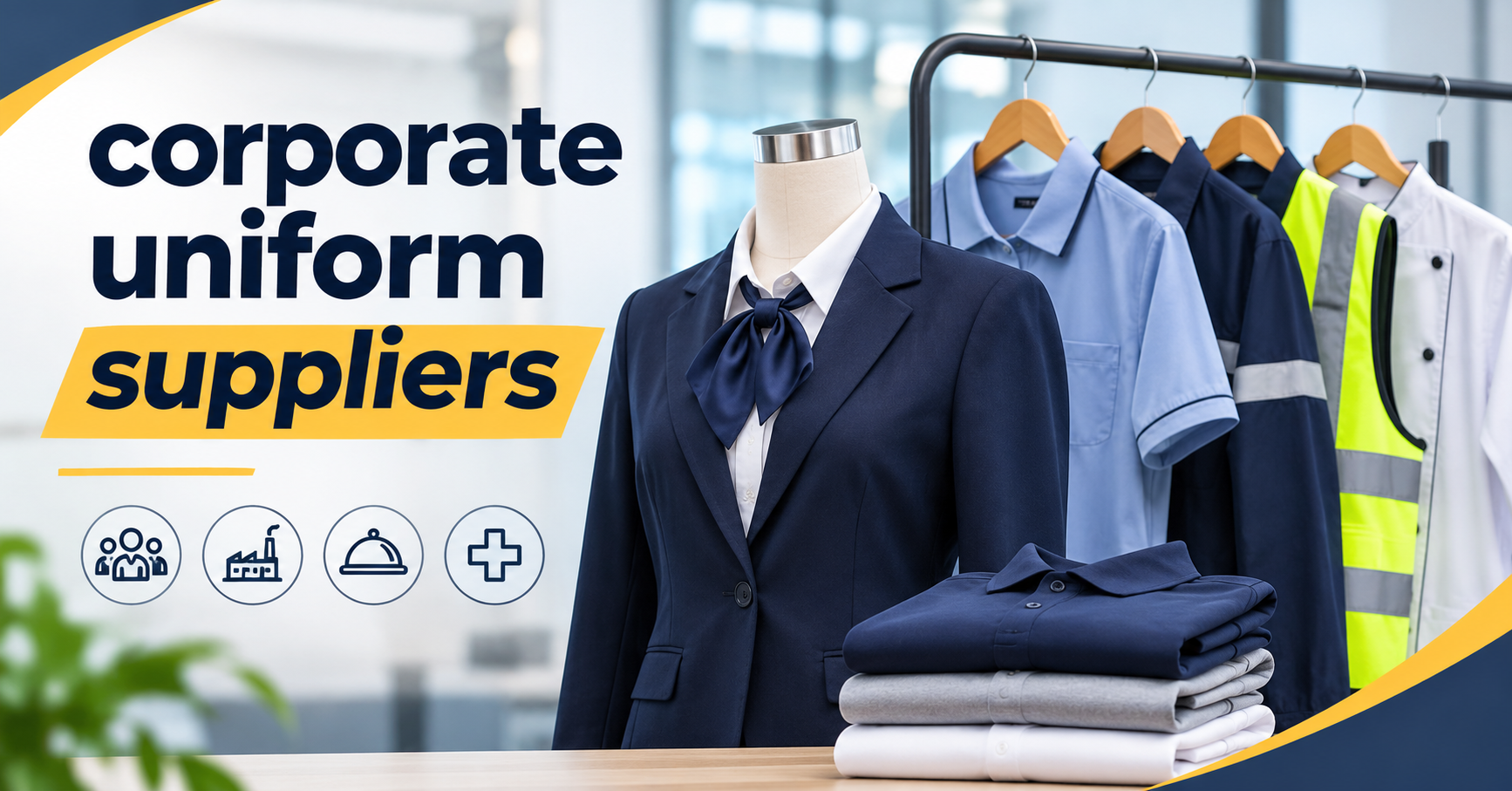
Quick Summary: Corporate uniform suppliers in the UAE fall into three groups: manufacturers, trading houses, and resellers. Knowing which one you are dealing with changes how quickly problems get fixed, how decoration is controlled, and what a quote actually covers.
Two uniform quotes can look identical on paper and still come from very different businesses. One supplier sews the garment in its own factory. Another buys finished stock and adds a logo.
Neither model is wrong, but they behave differently when a sleeve is cut short, a colour is off or a reorder is needed in a hurry.
Procurement teams often shortlist suppliers on price alone, and the real differences only show up later, when a reorder or a correction is needed.
Most comparison guides ask buyers to check price and delivery. This article starts earlier, with a simpler question: who actually makes the garment, and why does that matter for a corporate order? The answer affects every custom uniform project that follows.
Why Does the Supplier Type Matter for a Uniform Order?
Supplier type shapes the three things buyers care about after the order is placed: control, speed and accountability. A buyer who understands the model can predict how problems will be handled.
A supplier that controls production can adjust patterns, fabrics and decoration directly. A supplier that sources from others can still deliver well, but fixes often travel through an extra layer of communication.
What Is the Difference Between a Manufacturer, Trader and Reseller?
The labels overlap in practice, and many suppliers mix models. These definitions give buyers a working framework for the conversation.
Manufacturer
A manufacturer cuts, sews and finishes garments in a factory it operates or controls. Pattern changes, fabric choices and quality checks sit under one management.
Trading House
A trading house sources garments or fabrics from several factories and sells them under one account. Range can be wide, but production details depend on the partner factory.
Reseller or Decorator
A reseller buys finished garments, often from catalogues, and adds embroidery or printing. This model suits small quantities of standard styles, with less room for changes to the garment itself.
Apparel Point Trading LLC describes a Dubai head office and a factory in Ajman, together with in-house embroidery, printing and design, which places the company closer to a manufacturer-and-supplier model for decorated uniforms. Buyers should still verify any claim they rely on, which is the focus of the next section.
Which Questions Reveal Who Actually Makes the Garment?
Direct questions work better than assumptions. A supplier that makes garments will usually answer these without hesitation.
- Factory location: Ask where the garments are cut and sewn, and whether a visit is possible.
- Decoration: Ask whether embroidery, printing and sublimation are done on the same premises.
- Fabric source: Ask where fabric is purchased and whether a swatch card is available.
- Certificates: Ask for any quality certificate the supplier claims, such as ISO 9001, and check what the certificate covers.
- Samples: Ask whether the sample is made on the same line as the bulk order.
The certificate point deserves care. Apparel Point states that ISO 9001:2015 applies to the Ajman manufacturing facility, which is a statement about that site rather than every activity of the company, and buyers can ask for the certificate to confirm the scope. With the answers collected, the next step is comparing what each model means in practice.
How Does Supplier Type Affect Price, Speed and Fixes?
No model is cheaper or faster in every case. The differences usually appear around changes and problems, not on a standard order.
When a pattern needs adjusting for a different body type, a manufacturer can often change the cutting stage directly. A reseller can usually only swap to another catalogue style. Where a defect is found after delivery, ask who authorises the replacement and how long the process takes.
Apparel Point states that free replacement is offered for manufacturing or fabric defects and that customisation takes at least one to two business days. Buyers can use statements like these as a baseline when asking other suppliers for equivalent terms.
Which Supplier Model Suits Which Kind of Business?
The right model depends on volume, complexity and how often the uniform changes. Use the guide below as a starting point.
- Large or multi-site teams: Consider a supplier that controls production, so patterns and colours stay consistent across reorders.
- Small teams with standard styles: A reseller or decorator can be efficient when the garment itself needs no changes.
- Mixed requirements: A trading house with a broad range suits buyers who need several garment types on one account.
Buyers sourcing corporate uniforms for offices, hotels or logistics teams can take any of these routes, provided the supplier is honest about its model. Ask the questions, compare the answers and request a sample before committing.
Frequently Asked Questions About Corporate Uniform Suppliers in the UAE
- How do I know if a uniform supplier has its own factory? Ask for the factory location, request a visit or photos, and check whether embroidery and printing are done on the same premises.
- Is a manufacturer cheaper than a trader? Not necessarily. Price depends on quantity, fabric and decoration, so compare written quotes on the same specification.
- What does ISO 9001 mean for a uniform supplier? It relates to a quality management system. Check which site or process the certificate covers.
- Can a small business order corporate uniforms in the UAE? Yes, though minimums vary by supplier. Apparel Point states that there is no minimum quantity, so confirm terms at the quote stage.
- Which documents should I ask for before ordering? Ask for a written quote with fabric, decoration method, sizes and delivery date, plus any quality certificate the supplier cites.
- What should a uniform sample show? It should match the fabric, colour, logo position and construction of the bulk order, and it should be washed once before approval.